In this episode, Ndukwe and Cheta examine Andy Burnham’s appearance on Good Morning Britain, where the former Mayor backed settlement as a right earned through contribution — but would not put his name to the 15-year figure. They dissect what that careful non-answer reveals about the pressures on politicians who must hold a fractured coalition together, and why the people who can speak most freely on migration are rarely the ones most affected by it.
The weight of words
Ndukwe opens with a deceptively simple observation: in politics, even the most routine statement is a calculated risk. The Prime Minister’s word choices on a morning sofa tell you less about his convictions than about the audience he is performing for. That framing sets the tone for the episode’s central argument — that political communication is not about truth, it is about coalition management.
“When the Prime Minister says good morning, people analyse the tone and intention behind it.”
Ndukwe Onuoha
Cheta extends this to the structural reality of governing: every politician is running several conversations at once, each with different stakes. The performance of sincerity and the reality of calculation are not opposites. They are the job.
“As a politician, you’re juggling numerous conversations, each with different stakes. It’s a delicate balancing act that often leads to perceptions of insincerity.”
Cheta Nwanze
The dance of political statements
The discussion moves to Burnham’s specific handling of the 15-year ILR question. He backed the principle. He did not back the number. Ndukwe identifies this as a textbook political move — signal solidarity with the reformers, keep your options open with the resisters, give no hostage to the press. The problem is that for the hundreds of thousands of people whose settlement timeline hangs on this decision, the ambiguity is not a political tactic. It is their life.
Cheta reads Burnham’s reticence as a direct reflection of where Labour is internally. More than a hundred MPs oppose the 15-year route. The major unions oppose it. Angela Rayner, as Housing Secretary, has called retrospective application ‘unfair and un-British’. Burnham’s dance is not personal evasion — it is a map of the party’s fault lines.
Race and political discourse
The episode’s most pointed exchange concerns who gets to speak plainly in Labour and who does not. Rayner’s willingness to name the retrospective element as un-British is contrasted with the more guarded language of ministers from minority backgrounds. Cheta is direct about what is happening here.
“Angela Rayner’s ability to speak her mind without fear of repercussions illustrates the dynamics of privilege in the political sphere. It’s an unspoken rule that those from the majority often have more latitude in their expressions.”
Cheta Nwanze
Ndukwe nuances this: Rayner’s track record and authenticity matter too. But the structural point stands. Race shapes not just who is in the room, but who can afford to be unambiguous once they get there.
Jobs, labour and the migration story
The second half turns to the ONS jobs data and the political claim that migrants are displacing British workers. Ndukwe and Cheta take that claim apart sector by sector. In care, farming and hospitality, the labour gap is structural — it predates recent migration patterns and was made significantly worse by Brexit. The political narrative of displacement is simpler than the economic reality, and simplicity, as this episode argues, is the point.
The conversation holds two things at once: the state recruited 280,000 people on the Health and Care Visa between 2022 and 2025, then closed the route without a plan for keeping the workforce it had built. The Budget is largely silent on this. If the ILR wait stretches to fifteen years for care workers, the consequences fall on both the workers and the wards they staff.
Closing: Reform, identity and faith
The episode closes with the hosts reflecting on Reform’s growing support, political identity, and the underexamined role of religious conviction in how Black and minority communities vote. These are threads the show returns to across the series — who our communities trust, who earns that trust, and what it costs when it is withdrawn.
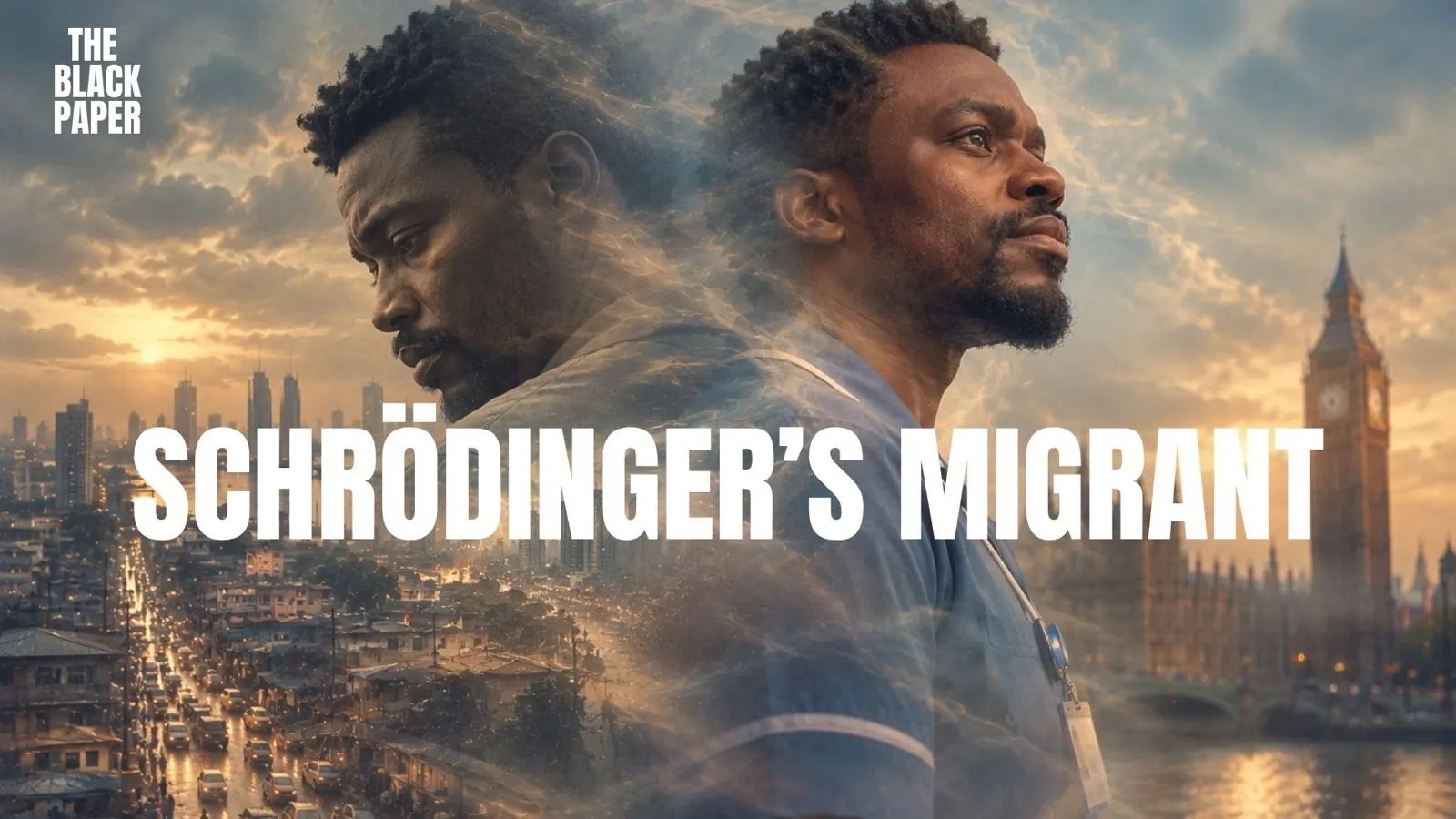
Schrödinger’s migrant is a live condition, not a metaphor. The box is the ILR consultation. The question is whether, when it opens, the people inside get to stay.